Stoat breeding season has well and truly begun, and most of the female stoats remaining in Orkney will currently be hidden away in their dens. But our work still continues!
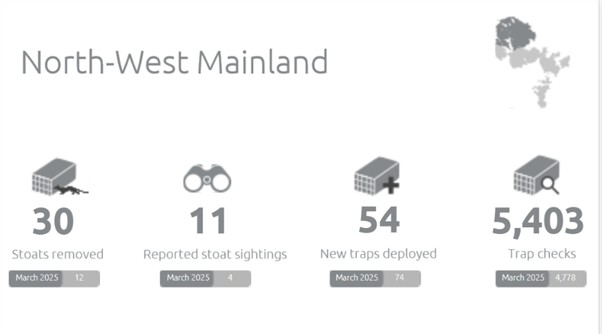
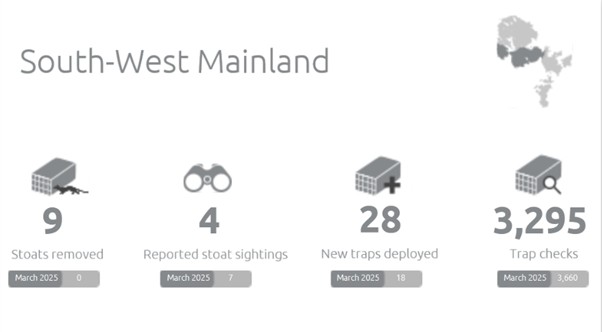
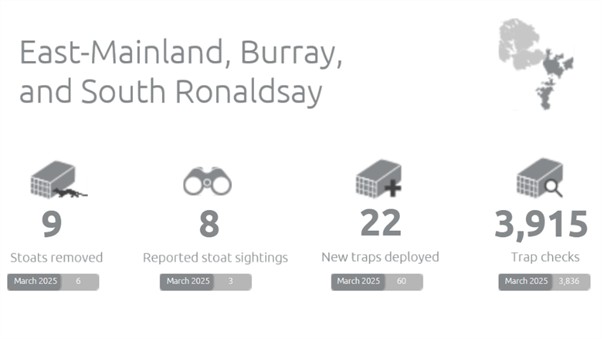
The overall number of stoats caught in March across Orkney was lower than in February, especially in East Mainland, Burray and South Ronaldsay. This was expected, due to the reduction in activity by breeding females, but it also likely indicates that overall stoat numbers are still decreasing due to our trapping efforts.
However, we did see a general increase in stoats caught this year compared to March 2025 in all regions, showing that our more intense and targeted trapping techniques are working.
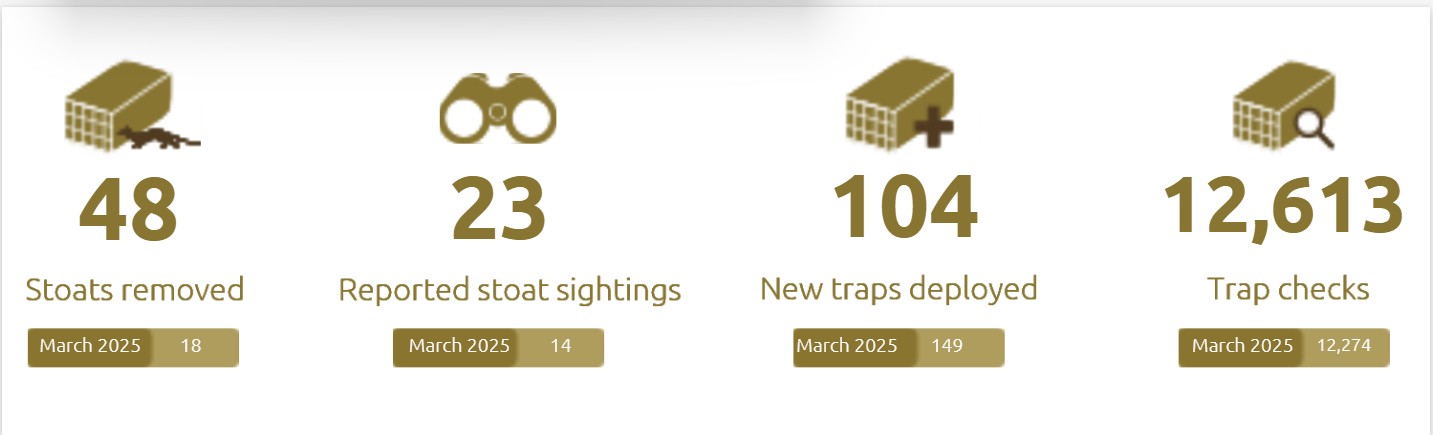
Overall, we removed 48 stoats from Orkney, through 12,613 trap checks – an increase of 30 stoats compared to last year. We deployed 104 traps, which is 45 fewer than in March 2025, since many priority areas already have extensive trap coverage.
We also saw an increase in stoat sightings from members of the public, and would like to heartily thank everybody who called their report in.
A note on bycatch in our traps
People are sometimes curious about how frequently we catch non-target species. We take all possible measures to ensure as few other animals are caught as possible. Our traps are constructed and set to prevent other animals from being caught, and we use lures designed to specifically catch stoats. The entrance hole design, trap housing, and trap calibration all work to help minimise bycatch of other species.
The main non-target species we can’t do anything to reduce catching is the brown rat, due to its similar size and weight to stoats. Over the ten months from May 2025 (the last time we shared bycatch figures) to April 2026, we caught 5235 rats, 427 rabbits, 187 mice, 86 starlings, 41 hedgehogs, 30 voles, 25 frogs, and 44 unidentifiable birds, rodents, or other animals. Several of these species, like brown rats, are also not native to Orkney. In the same period, we also removed 1080 stoats. Since a single stoat must eat the equivalent of one Orkney vole a day just to survive, any impact of our trapping on voles will be far outweighed by the benefits of removing stoats from the islands.
Want to get involved?
Orkney is heading into the heart of spring, and that means we are starting to monitor our native wildlife. Volunteers assist us with a lot of our wildlife surveys, including the search for signs of Orkney vole activity.
Training is provided and previous experience isn’t necessary. If you’re interested, please apply at the following link: https://volunteer.rspb.org.uk/opportunities/74712-surveyor-not-on-a-reserve-orkney-local-nature-conservation-sites