
Report a Sighting arrow-right

New report shows vole and hen harrier numbers rebounding in Orkney

A report released today shows that many of Orkney’s most iconic native species are increasing in number – thanks to efforts to remove stoats from the county.

Last year saw records broken for Orkney vole abundance, and hen harrier breeding activity as well as high numbers of breeding short-eared owls. The increases are associated with a reduction in the number of invasive non-native stoats as the Orkney Native Wildlife Project’s work to remove them progresses.

In 2025, Orkney vole activity in spring was the highest since 2019, when the Orkney Native Wildlife Project began regular surveys, and autumn activity was also high. In addition, the number of confirmed hen harrier breeding attempts was the highest it has been in more than a decade, and the number of short-eared owls recorded during the breeding season remained high, having recovered from low levels reported in 2019-20.
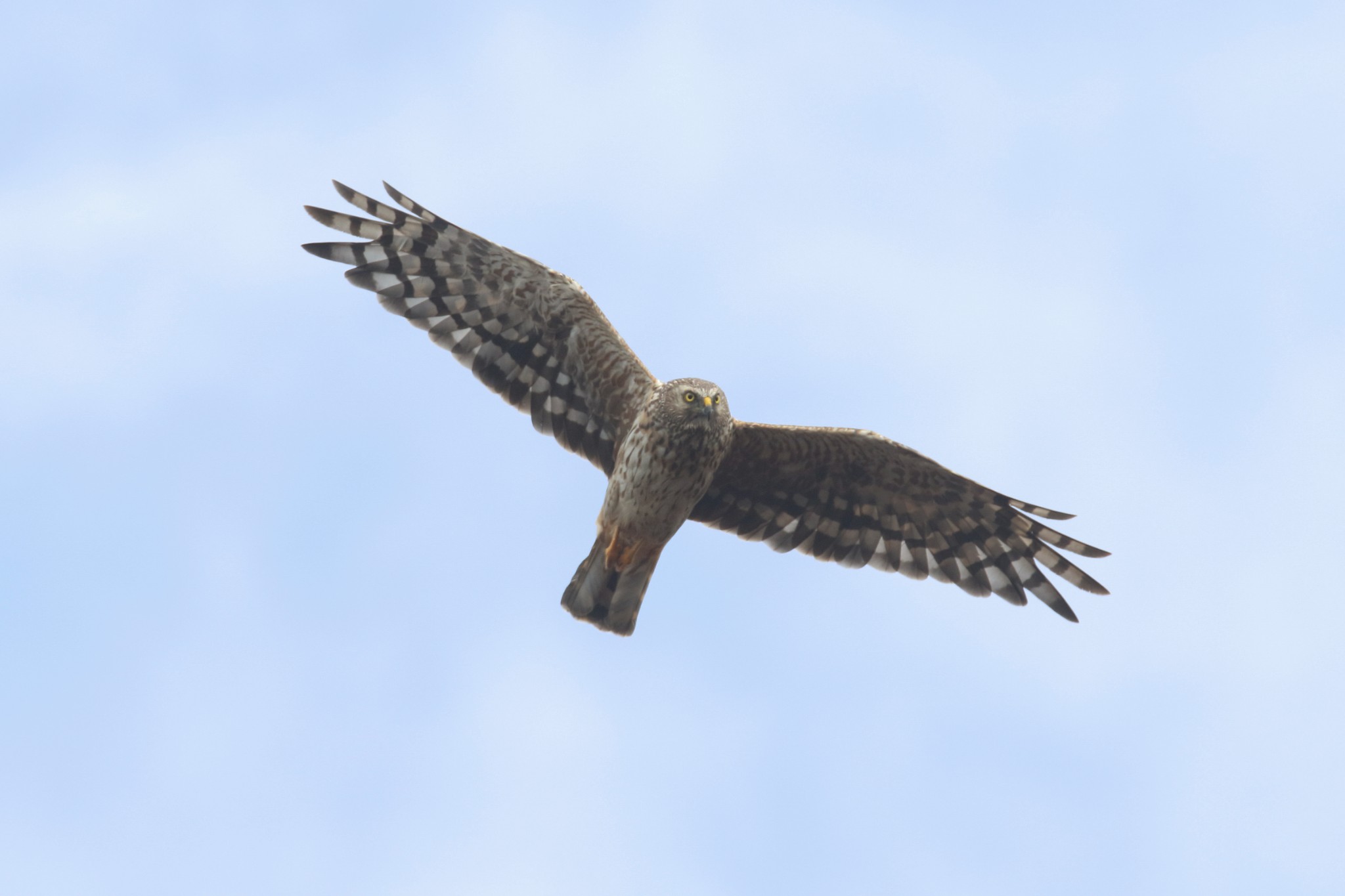

Furthermore, hen harrier breeding attempts and breeding success over six years were strongly associated with vole abundance.

Orkney voles are surveyed by looking for signs such as droppings and grass clippings (which are left behind from feeding). In spring 2025, the number of signs spotted were the highest recorded in any year since annual surveys began in 2019. Across 22 sites surveyed in Mainland Orkney and the Linked Isles, vole signs were found in one-third of the small survey squares searched (358 out of 1082).

In 2025, monitoring by the Orkney Raptor Study Group included 201 Mainland sites checked for hen harrier occupancy, with breeding proven at 74 sites – the highest number since 2012. Sadly, this did not result in record breeding success due to wet weather at a critical time resulting in high chick mortality. Despite this, it is thought nearly 60 chicks still successfully fledged in 2025 from monitored nests – a not insignificant number given the total hen harrier breeding population in 2023 in the UK/Scotland was 653/529 territorial pairs.

For short-eared owls, which are notoriously hard to survey, birds were confirmed at 55 locations on islands with stoats during the breeding season, with proven breeding at 16 and nests found at six places by the ORSG. The results show a continuation of the increase in breeding site occupancy for short-eared owls since 2019, when the project began removing stoats.

More intensive monitoring of Orkney voles has been happening since 2019 as part of the ONWP’s activities. An analysis of hen harrier breeding data between 2019 and 2025 has shown a close link between the improved numbers, and the recovery of Orkney vole populations. Vole abundance in the spring surveys was positively correlated with hen harrier presence in the breeding season, and particularly strongly correlated with breeding attempts. Furthermore, nest success rates were associated with autumn vole abundance.

Matt Marsh, Monitoring Officer for the Orkney Native Wildlife Project, said: “It’s fantastic to see the continued positive impact that removing stoats from Orkney is having on our native wildlife. Hen Harriers are one of the most fascinating species we monitor, as well as being one of the rarest birds of prey in the UK, so it’s excellent to see that their numbers are increasing.

“We’re also very excited about what these studies can tell us about their relationship with the island’s vole population. Orkney voles are found nowhere else in the world and are the species that is probably most threatened by the arrival of stoats, so to see historically high rates of vole activity is very encouraging.

“It’s great to see the hard work of the project team and volunteers, and the strong levels of support from local communities, are starting to turn the tide for these vulnerable species. Ongoing monitoring is critical to understanding and addressing current and future threats to Orkney’s native wildlife.” 

Taken together, these results support the findings of a 2015 study on the anticipated effect of the arrival of stoats on Orkney’s native wildlife which predicted that, without intervention, stoats would have a devastating impact on Orkney’s native wildlife particularly voles, hen harriers and short-eared owls.

Given Orkney is home to a sizeable proportion of the UK’s hen harrier population, the results have UK-wide significance for one of our rarest birds of prey.

They also suggest that without the actions of the Orkney Native Wildlife Project and the support of so many people across Orkney, the county’s natural heritage would be in trouble. Lots of factors influence population trends in voles and birds of prey including weather, but these are encouraging signs that the efforts that have removed more than 8,500 stoats are helping these vulnerable species.

Graeme Walker, a long-time volunteer with the project, said: “I’ve taken part in the vole monitoring survey every year since 2019, and every year, we’ve seen their numbers increase.

“It's been great to see the positive impact that removing stoats has had on the voles I have been surveying. It’s fantastic that this iconic species is coming back so strong – and in turn, they’ll be helping Orkney’s native birds of prey to thrive as well.” 

Speaking on behalf of the project, Sarah Sankey said: “Year after year, the results from efforts to monitor trends in native wildlife are showing us the positive impact removing stoats from Orkney is having.

“Invasive non-native species are a significant threat to island wildlife and removing them is essential to giving Orkney’s native wildlife their best chance for the future, as well as sustaining the parts of our economy that relies on it.

“These results show the difference our efforts are making, and everyone involved in the progress so far should be really proud. But we can’t rest yet, we need to all come together to finish the job as soon as possible to not put what we’ve achieved so far at risk”.

All the monitoring data was collected thanks to volunteers from the local community, the ORSG and local staff. Additionally, members of the public report sightings of short-eared owls to ONWP. These are collated each year for potential future analysis. In 2025, 51 records were submitted, providing valuable additional information on short-eared owl distribution in Orkney on top of the breeding data collected by the ORSG.

This shows how essential volunteers are for the understanding what is happening to native wildlife. Anyone interested in joining the survey efforts this year should visit RSPB Volunteering, at the following link.

The ONWP is funded by partners including The National Lottery Heritage Fund, EU Life, and the Scottish Government’s Nature Restoration Fund, managed by NatureScot. The project is the largest of its kind in an inhabited landscape, and the first to be attempted in the Northern Hemisphere.

Read the 2025 Wildlife Monitoring Report summary here

More information

  • About the Orkney Native Wildlife Project
    • The Orkney Native Wildlife Project is a partnership between RSPB Scotland, NatureScot and Orkney Islands Council. It has the generous support of the National Lottery Heritage Fund, EU Life and the Scottish Government’s Nature Restoration Fund, managed by NatureScot, as well as financial and in-kind contributions from partners.

    • The project is the world’s largest and most ambitious stoat eradication to date. It employs more than 40 people and involves the use of Europe’s first conservation detection dog team. Being the first of its kind at this size and scope means lessons learned are of international interest and consequence.

    • The project began trapping in 2019, after a consultation period which indicated extensive support for Orkney’s wildlife: 92% believe we have a duty to protect Orkney’s wildlife for future generations; 88% are worried about the decline in native wildlife if stoats are not removed from the islands; 84% thought it was important to eradicate stoats from Orkney. The project has worked with more than 1190 landowners, received the equivalent of twelve working years in volunteer hours and conducted more than 701,000 individual trap checks.

    • The project has removed more than 8,500 stoats from Orkney using humane lethal traps which comply with the Spring Trap Approval Order. There are 8,813 trap boxes (including network, response, and biosecurity) deployed as of 20 March 2026, most of which contain two DOC-200 spring traps. The majority of the traps are ‘network traps’. These remain in the field permanently and are checked on a regular schedule. ‘Response traps’ are deployed in response to public sightings or detection dog indications, while ‘biosecurity traps’ are deployed on the islands which are believed to be free from stoats.

    • The project is following international best practice for conducting an invasive species eradication. The methodology was initially to significantly reduce (technically known as ‘knock-down’) stoat numbers with network traps and ‘mop-up’ the remaining stoats once there were few enough to respond to all public sightings. The two-year monitoring period which follows the eradication before it can be declared successful is also international best practice. If a stoat is found within this period, it will be removed, and the clock reset.

    • The project is split between eradication and biosecurity. The eradication effort focuses on removing stoats from the Orkney Mainland and Linked South Isles where the invasive population is established. The biosecurity programme is intended to prevent stoats from colonising the stoat-free Orkney islands.

    • The project’s stoat detection dogs, which were Europe’s first, were initially used for checking whether stoats had established on other islands. They are now used for following up public sightings and conducting area searches to help the project target its trapping effectively. Most of these detection dogs indicate when they locate stoat scat (poo). Others indicate when they scent the recent presence of an actual stoat. All the project’s detection dogs are trained not to interact with the stoats themselves.

    • More information available on the website, www.orkneynativewildlife.org.uk, Facebook page www.facebook.com/OrkneyNativeWildlifeProject

  • The importance of Orkney’s native wildlife  
    • Despite being less than 1% of the UK landmass, it is home to 15% of its hen harriers, 6% of its breeding seabirds, very high densities of breeding curlews, and important populations of lapwing, oystercatcher, and the Orkney vole, a subspecies found nowhere else in the world. Many of these species are struggling to adapt to the pace of change on the UK mainland, meaning that their survival in Orkney has national and sometimes international significance.
    • Situated on the East Atlantic Flyway, a migration route used by over 155 species, Orkney is also a crucial stopping off point for huge numbers of migratory birds.

    • This abundance of wildlife has major benefits for the local economy. Orkney has a thriving wildlife tourism industry. Visitors spent £70 million in 2019-20, with 46% of visitors engaging in wildlife watching activities (Island visitor survey commissioned by Orkney Islands Council in partnership with VisitScotland).

    • In 2019, farmers in Orkney received £2.35 million in Agri-Environment Climate Scheme payments (9% of all Scottish payments despite being just 1.3% of its land area). These payments are at risk if wildlife like curlews and hen harriers decline in Orkney.

    • Since 2019, when trapping started, the number of successful curlew nests has increased on the Orkney Mainland (the area under eradication) and in 2022-2023, almost 83% of oystercatcher nests survived until hatching.

  • Stoats and their impact on native wildlife
    • Stoats (Mustela erminea) are native to the UK Mainland but not to Orkney, where they were first recorded in 2010. Since then, the population has increased and has spread throughout Mainland Orkney, and the linked isles including Burray and South Ronaldsay.
    • Stoats are very skilled hunters. They are fast and agile and good climbers with very good eyesight, hearing and sense of smell. They typically feed on small mammals, birds and eggs but can kill prey much larger than themselves. They also tend to kill more than they need and hide (cache) the rest to eat later. In Orkney, caches containing as many as 100 Orkney voles have been found. With no natural predators in Orkney, they pose a very serious threat to Orkney's native wildlife.

    • Stoats have played a critical role in the extinction of several species elsewhere in the world. They were introduced to New Zealand in the 19th century in an attempt to control invasive rabbits. Instead, they contributed to the extinction of the laughing owl, South Island kōkako, and mātuhituhi, all ground-nesting birds. To this day, they continue to threaten the iconic kiwi.

    • Although common throughout mainland Britain where they are native, stoats are usually shy and elusive creatures. In Orkney, their unusually bold behaviour is likely due to the abundance of food (in the form of ground-nesting birds and Orkney voles) and a scarcity of natural predators.

    • In 2014, NatureScot commissioned a report: Stoat on the Orkney Islands – assessing the risks stoats posed to native species (SNH Commissioned Report No. 871). The report concluded that stoats threaten several species both directly and indirectly, including: the Orkney vole, hen harrier, short-eared owl, and many ground-nesting birds. The report recommended that removal of stoats is the best option to safeguard Orkney’s wildlife and prevent knock-on-effects to Orkney's wildlife tourism industry as well as other activities such as poultry rearing.

  • The costs of invasive species 
    • According to the United Nations, invasive non-native species cost the global economy £338 billion every single year. From Asian hornets to giant hogweed and even stoats, invasive species are having a colossal impact on ecosystems, economies, infrastructure, and more in the UK.
    • Invasive species are responsible for 40% of extinctions worldwide in the past 400 years. Despite making up less than 6% of the world’s surface, 60% of extinctions in this period have taken place on islands.

Back to News & Events
Sign up to get the latest news
Subscribe arrow-right

Get Involved

volunteer
Volunteer
brown-stoat
Report a stoat
offer-land-access
Offer land access
donate
Donate